
₹96.80 Per Dollar: Why the Indian Rupee Is Falling in May 2026 — Impact on Inflation, Travel & Economy
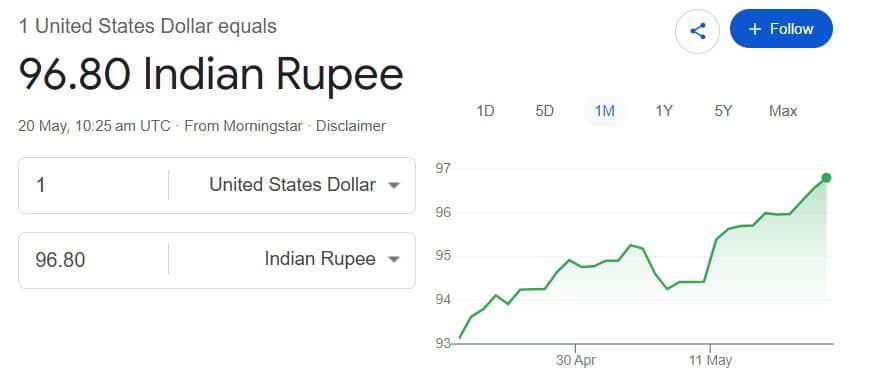
The Indian Rupee has weakened sharply in May 2026, touching nearly ₹96.80 per US Dollar, one of the weakest levels in India's history. The fall reflects growing pressure from high crude oil prices, global uncertainty, foreign investor outflows, and a strong US dollar.
While a weak rupee creates challenges for importers, travellers, and inflation management, it also benefits exporters and NRIs sending money back home.
Here is everything you need to know about the rupee fall and its impact on India.
Rupee Near Record Low — What Happened?
The rupee has depreciated significantly over the past year and is currently trading around ₹96.80/USD.
Key Rupee Data — May 2026
| Metric | Value |
|---|---|
| Current USD/INR Rate | ₹96.80 |
| 2026 High | ₹96.54 |
| 2026 Low | ₹89.86 |
| 2026 Average | ₹92.45 |
| 12-Month Decline | ~12.6% |
The sharpest depreciation has happened in recent weeks as global oil prices surged and the US dollar strengthened further.
Why Is the Rupee Falling?
Several major economic factors are driving the rupee lower.
Crude Oil Above $100 per Barrel
India imports nearly 90% of its crude oil requirements. Brent crude trading above $107 per barrel has sharply increased India's import bill.
Higher oil imports mean India needs more US dollars to pay for crude, increasing pressure on the rupee.
Strong US Dollar
The US Federal Reserve continues to maintain higher interest rates, strengthening the dollar globally.
As US bond yields remain attractive, global investors are moving money into dollar assets, weakening emerging market currencies including the rupee.
Foreign Investor Outflows
Foreign Institutional Investors (FIIs) have been reducing exposure to Indian markets in recent weeks.
This capital outflow increases demand for dollars and contributes directly to rupee depreciation.
Fuel Price Hikes in India
India recently increased petrol and diesel prices multiple times in a single week, adding inflationary pressure across sectors.
Higher transportation and logistics costs eventually increase prices of goods and services throughout the economy.
RBI Intervention
The Reserve Bank of India has been actively selling dollars in the forex market to reduce excessive volatility.
However, the RBI is attempting to slow the rupee's fall rather than completely stop market-driven depreciation.
Impact on Ordinary Indians
The falling rupee affects almost every part of the economy.
Who Gets Hurt?
Importers
Electronics, machinery, crude oil, and imported goods become more expensive.
Students Studying Abroad
Tuition fees and living expenses in the US, UK, Canada, and Australia rise significantly in rupee terms.
International Travellers
Foreign travel becomes more expensive as hotel, flight, and shopping costs increase.
Inflation
Imported inflation increases pressure on food, fuel, transportation, and consumer goods prices.
Who Benefits From a Weak Rupee?
IT & Software Companies
Indian IT firms earn revenue in US dollars but spend largely in rupees, improving profit margins.
NRIs Sending Remittances
Families receiving money from abroad get more rupees per dollar transferred.
Exporters
Textile, pharma, manufacturing, and export-oriented businesses become more competitive globally.
Quick USD to INR Conversion at ₹96.80
| USD | INR |
|---|---|
| $100 | ₹9,680 |
| $500 | ₹48,400 |
| $1,000 | ₹96,800 |
| $5,000 | ₹4,84,000 |
| $10,000 | ₹9,68,000 |
What Happens Next?
Economists believe the rupee could stabilise between ₹94–₹98 per dollar in the near term depending on:
- RBI intervention
- Crude oil prices
- US Federal Reserve policy decisions
- Global geopolitical tensions
- Foreign investment flows into India
If oil prices remain elevated above $100 per barrel, pressure on the rupee may continue.
Conclusion
The weakening rupee is becoming one of the biggest economic stories of 2026. While India's long-term economic fundamentals remain strong, rising oil prices and global uncertainty are creating short-term challenges.
For ordinary Indians, the impact will be visible through higher import costs, expensive foreign travel, and inflation pressure. At the same time, exporters and NRIs could benefit from the weaker currency.
The coming months will largely depend on global oil markets, RBI intervention, and US monetary policy.
Sources: TradingEconomics, Wise, Bloomberg, BookMyForex — May 2026